Tuesday, May 30, 2006

mmmm.. I want me some roast ducky!

These pics were taken during a weekend hike. and puhleeease don't you all go "awwwww" on me.Oh, and i'm back from Pommieland. So watch this space .

Wednesday, May 17, 2006

break

mes amis:
i'm off to pommie-land for the next few days. blogging will be light (as if i blog a lot, otherwise)

Saturday, May 13, 2006

crash

By the time we arrived at the scene, the firemen were already there - their fire engine parked across the Brookly Queens Expressway. A lone cop car had stopped all traffic, and as we waited, the firemen went to work on the car.

It was a regular new york yellow cab. A tractor-trailer had rear-ended it, the force of the impact crumpling its rear half, flipping it over, and leaving it pointing in the direction of the on-coming traffic, wedged against a side-rail. Needless to say, the giant truck had fled the scene.

The gas tank had ruptured, sending gas flowing on to the road. That explained the firemen. The rear door was jammed, and inside, trapped, lay someone unconscious.

Within a few minutes, the sounds of emergency sirens - cop-cars, ambulances and fire engines surrounded us. These are sounds you hear all the time in this city - sounds that you become inured to, until you are confronted with something like this that reminds you that everytime those sirens blare, someone is dying.

I watched with a little concern as the stream of gas flowed towards my car. Just then, I noticed that the driver of the car next to me had stepped out, and was smoking. I yelled at him. He acknowledged my existence with a nod and a shrug. He did not stop smoking, of course.

My cabbie was Jamaican, he had been driving a cab for twenty years. This should have been a scene not entirely unfamiliar to him - and yet he was furious. He stepped out of the car started swearing at everybody -cops included. I understood his being upset, but not the degree of it. Until I finally made out, underneath all the incoherence, what he was saying - "They killed my friend. Ten years ago. Same place. F**kin' juggernauts"

It's a friendly city - this one. The aforementioned smoker put an arm around my cabbie's shoulders, took him aside and calmed him down. Most people had stepped out of their cars by now. There were shrieks and gasps as the firemen pried the door open and pulled out a bloody mess that had been, until a few minutes ago, a normal functioning person. Apparently he was still alive, but not breathing. The firemen started administering CPR. The snarl of traffic backed up behind us meant that the paramedics had not arrived. I had stepped out by now. The woman next to me was sobbing.

The cops did not particularly appreciate the standing crowd, so they shooed us back into our cars. My cabbie was agitatedly sobbing. I had no idea what to do - so I ventured a "I hope he does not die"

"He's dead, brother. Crash like that nobody survives", retorted my cabbie.

Another awkward silence.

The paramedics had arrived by now. They had come back down the empty stretch of highway that lay ahead of the crashed car. They put the guy on a stretcher, hooked him up to a ventilator and tried to restart his heart. I don't know if they succeeded, but they took him away. The firemen began hosing the highway to clean it of blood. They foamed down the gasoline.
Meanwhile, the cops made all of us back down along the BQE, and take the nearest exit out. It would be some time before they would restart traffic here. Presumably, after the cab had been towed off and the road sanitized of all evidence that a person had almost died there.

We made our way to my place via another route. I was a bit pained that my fare was almost twice of what it would have been otherwise, and at the same time a bit guilty for feeling that way instead of being concerned about the passenger in the crumpled cab.

As I reached out to pay the cabbie, he turned around, tears streaming down his eyes.
"Are you muslim, brother?"
"No."
"Are you a christian, then?"
"No, I'm Hindu"
"Do you pray, brother?"
I did not have the heart to tell him I did not.
"Pray tonight for him, will you?"
"Yes, I will", I told him. Then I entered my apartment. The smell of gas had given me a headache and made me nauseous. I threw up and fell asleep.


I wish I could live forever.

Wednesday, May 03, 2006

gagging on a tag

So, the other day, i was tagged by Brown Magic, who, rightly, thought that I would not follow through with it. I would not have, except for the fact that she actually stated it in her comment. That and the fact that I couldn't possibly let go of an "eight different points you want in the perfect lover" tag without having my say in the matter.

The first time I attempted to put down eight points was when I was in a particularly, let us say potty-brained, mood. This resulted in a post that included descriptions of acts that I could not possibly put on this blog.

So I sat down, thought hard, awaiting inspiration to write about my idea of *the* perfect woman. And then, all of a sudden, a name bubbled up from the murky depths of my mind - a name that had been consigned to the recycle bin of my brain by my sheer denial of its existence. So instead of listing out eight points, I thought that I would describe her and allow you to draw your own inferences.

Her name was Pankajavelli Ramadesigan. She was a simple girl who was born and raised in a somewhat typical Iyengar family. Her father (Mr. Yes. Ramadesigan, Railway Officer (Retd.) , Railway Caalany, Madurai) had spent a lifetime in "service". She had a "mix of traditional and modern values" - she had done her Bachelor of Arts (Home Sciences) with distinction, and yet she went to the temple every Saturday. I would have fond memories of hanging around outside the temple waiting for her to make an appearance - my pankajavelli, walking delicately, plate of offerings in hand, wearing a silk sari. She would wear her long hair (they reached down to her knees) in a plait - a veritable garden, in which she would attach jasmine flowers. She had the thickest, finest hair I would ever set my eyes upon - nourished over the years with generous doses of coconut oil. The combined fragrances of jasmine and coconut oil would drive me crazy. really.

She was what you folks might call a "prude". Drinking would be a strict no-no for her, and eating meat would be sinful. She was not even okay with other people eating meat - the first time she went to eat "north-indian" food, she was horrified to find that the people next to her were eating parrot meat. (I surmised that it must have been someone eating green kebabs.) The very mention of anything sexual would have her saying "Ranga, Ranga" and going off to bathe in order to cleanse herself. She would have a dim view of the concept of romantic love. ("lovvulla- givvulla" she would say, imitating her father.) And all of these qualities would make me fall madly in love with her.

Somehow I had the conviction that I would be able to convince her to think of me as her partner-for-life. I even thought that I would approach her father, and convince him to give me his daughter's hand in marriage. Using the little influence her father had, and my qualifications, I would get a job as a low-level functionary in the railways. Everyday, I would come back home from work, tired, and she would be waiting for me, steel tumbler of steaming hot filter kaapi (coffee) ready . As I sat back in the chair in front of our black-and-white TV (we would be poor, but comfortable), she would take my shoes off, and press my feet, while I would pour - Tam-style - the scalding hot coffee straight into my mouth without letting my lips touch the rim of the tumbler. Sitting at my feet, she would contentedly say, "Swaami, Namaskaram". And we would live happily.

But, alas, that dream of mine would remain a dream. She could never reconcile herself to the fact that I was not Iyengar (heck, i'm not even Tam and, at that point, I had never been to Tamland). She would rebuff my advances. Meanwhile, her father would find her a nice boy (and a successful one too - a bank officer in the local Canara Bank branch), and marry her off to him. I would never forget her. I would spend the rest of my life roaming around all over India, travelling ticketless and using the money I made out of begging to keep myself in a perpetual drunken haze.

None of it was ever going to happen, of course. Pankajavelli existed only in my imagination and in the imaginations of a few friends who had helped flesh her out(1). You might think it is idiotic to create an imaginary person to fall in love with, who then refuses to have anything to do with you and leaves you miserable(2). I do not have much to say to that - my only defense is that love is blind and that the blog you are presently reading is titled "At the edge of sanity".

(1) Remind me some day to tell you about Parvinder Kaur from Gurdaspur.
(2) On a more serious note, this happens more often than you might think. More often than not, when we have a crush on someone, we are not in love with the *real* person, but with the mental image of the person that we have constructed in our heads.

Monday, May 01, 2006

Mother goose's rotten egg

Little Miss Muffet
sat on a tuffet,
Eating her curds and whey.
Along came a spider
who sat down beside her

and she beat the crap out of it.

Friday, April 28, 2006

Sorry for the lack of updates..

And to compensate for it, I will recite to you a ditty I learnt when I was a leeeetil kid.

Sorry Sorry, Gadhey Ki Lorry,
uspar baithi Meena Kumari,
Meena Kumari ka laal dupatta,
us-se nikala ullu ka paththa,
ullu ke paththe ne khaayi amrood,
us-se nikale Mr. Mehmood,
Mr. Mehmood ne lagaayi aawaaz,
Mahatma Gandhi Zindabaad!

* Apologies to the non-Hindi Speakers amongst my (mostly hypothetical) readers.

The problem, my dear readers, is that the wells of negativity that usually supply me with material for this blog have run dry. Not that I am *happy* or anything like that - it's just an annoying little phase of positivity that I am sure will pass.

I could rant about feeling positive because it makes me hate the world even more and cramps my style, but such ranting takes effort, and I am too lazy to do that. Meanwhile, it is every intention of mine to pile on drivel like this.

Monday, April 17, 2006

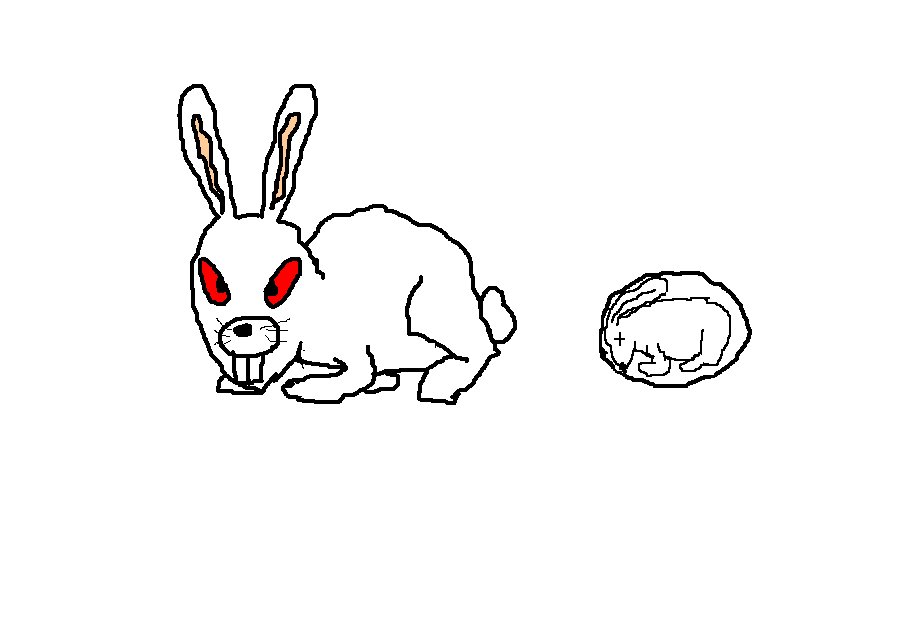
Happy Easter from mentaldeviation!


*Inspired by cheery "Happy Easter" posts like these.

Thursday, April 13, 2006

My reservations post

Since every self respecting blogger has made their voice heard in this brouhaha about reservations, I thought I would chip in too, being a self-respecting individual myself. :) The point I make might appear pedantic. Nevertheless, do hear me out. (Hello. Is there anybody out there?)

There is an important assumption made by proponents of reservations (and occasionally, this is a point conceded by those who oppose it). It sounds like the following:

The Backward Classes are disadvantaged. Hence they are unable to develop skills (that are required for competing). This is due to lower intelligence due to poor childhood nutrition, an environment that is not conducive to skill development, and other such factors. By enforcing quotas so that lower skill candidates get access to centres of excellence, the next generation is more likely to possess the skills required to compete, and society, as such, will benefit through access to more productive human resources (within multiple, if not within one generation)

Although it appears very plausible first hand, let us analyse the implications in terms of cost to society and productivity. Let us also (in a sense) bring in the notion of comparative advantage amongst groups, in a setting where the education of parents affects the skill sets of children. I will not address the issue of ``social justice", for it is not clear to me what that means. I will make the following assumptions.

1. There are two groups in society - The advantaged/high skilled group (H) and the disadvantaged/low skilled group (L). Time proceeds in discrete steps, each step corresponding to a generation.

2. There are two kinds of educational resources - Good (G) and Bad (B) with a fixed number of seats each.

3. Good educational resources are costlier to society.

4. Each agent, when she dies, produces a child. The child could be advantaged or disadvantaged with probabilities that depend on the kind of agent that she is, and the level of education she received.

5. The probabilities are such that if an agent has received good schooling, whether they were advantaged or not does not matter, they are equally likely to produce an advantaged child, and this likelihood is significantly greater than 1/2. On the other hand, disadvantaged agents that get poor schooling are very unlikely to produce advantaged children. This is the standard argument used in support of reservations.

6. Advantaged agents that are ``forced" to go to a bad school have a lower likelihood of producing an advantaged child than if they had got a good education. These likelihoods are indicators of social mobility, and will have a large role to play in our subsequent analysis.

Ok, so I hope you are with me. Go back to my assumptions and check them. Note down any disagreements. Especially look at number 5. It implies that regardless of what you do, in the ``steady state" there will always be disadvantaged agents in the society (and also, somewhat trivially, that the population is constant, which is not so serious, because I have never heard any arguments in support of reservations that appeal to population growth).

Now, coming to the productivity of the agents.

7. Before dying, agents produce an amount of goods that is defined by their productivity, and is more than the cost incurred for their education. The productivity of disdvantaged agents is lower than that of the advantaged agents (owing to lower skill-sets). The difference does not matter, it can be arbitrarily small. All that matters is that there is a difference. In my setting I use the following assumption: Productivity (H,G) > Productivity(L, G) > Productivity(H,B) > Productivity(L,B).

8. The total number of seats is the same as the number of agents. This is not such a serious assumption, because in the sense of our stylized setting, ``no education" can be defined as a very weak form of educational resource (with zero cost).

9. ``Good" seats are always scarce resources even for the advantaged group and even in the absence of reservations, in the sense that the number of good seats is less than the number of advantaged agents. Another very crucial assumption that is often ignored by those who advocate reservations.

10. The person who allocates seats to groups is a social planner who is looking to maximise the overall gain to society (production - cost of education). This is the same as the "society as a whole will gain" argument made by those who advocate reservations. The social planner also gives greater weight to gains in the near future than to those in the far future. (Discount factor less than 1)

Right then, so now let us look at what our social planner does. It is easy enough to analyze the ``steady state" that society reaches with these probabilities, with these
assumptions. Solving our little model mathematically , we can establish the following little factoid: For each constant reservation policy (defined as the proportion of good seats allocated to disadvantaged agents), there is a unique steady state. For a given value of parameters, the utility of the planner is monotonic (either increasing or decreasing) in the reservation policy.

That is, depending on the value of costs/productivities/progeny assumed, the ``best" reservation policy is either 100% or 0, but nowhere in between.

I am not going to go into the model, but i will intuitively explain it. What constrains the level of skill in society is the number of good seats. As long as good seats are scarce resources, society is always better of giving off all the good seats to the greater productivity agents. However, for some values of the probability of producing productive offspring and their relative productivities, it is always better for society to allocate all the good seats to the disadvantaged agents. The policy takes an "all or nothing" form depending the values of parameters.

What the model is very sensitive to is this: If the progeny of an advantaged agent who was forced to get a poor education still has a decent likelihood of being advantaged, and at the same time the progeny of a disadvantaged agent who was forced to get a poor education is very unlikely to be advantaged, then a policy of 100% reservations works. If the difference between these likelihoods is not as stark, then a policy of no reservations at all is the best policy.

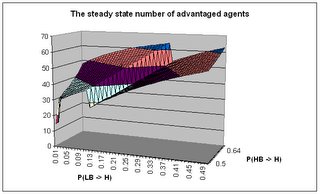
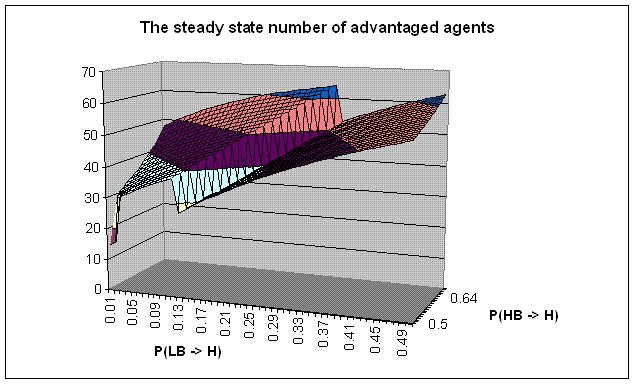
I will show you some pictures now. I have fixed the values of other parameters, and considered a population of 100 with 20 good seats available. The first picture is the effect the social mobility for poorly educated people has on the optimal reservation policy. The knife edge is clearly visible. The second is the gain to society depending on the mobility. It shows that society gains with greater social mobility. The third is the number of advantaged people in the society. You will see a cliff in this picture, and it corresponds to the knife edge where it suddenly become more optimal to have no reservations at all, and suffer a lack of advantaged workers.

The interesting point to be noted around this cliff that for the same level of utility to the planner, reservations increase the number of advantaged workers in society. I am unwilling, however, to attach any social justice implications to this. Have fun with these pictures. With such a simplistic model, it is amazing the level of complexity you can get. And I have not even talked about relative productivity effects!!

This is admittedly a rather shallow analysis, and I am sure alternate settings could be imagined, which could, perhaps lead to completely different conclusions. But it is very interesting indeed.

(This work is preliminary and incomplete and may not be cited.)

Thursday, April 06, 2006

Eulogy for a friend

My first encounter with Chris was on a hurried monday morning. I had picked up a bagel (cinnamon-raisin, toasted, with butter) at the bagel shop near the subway, and was on my way out, when I ran into an old gentleman slowly shuffling his way in. I excused myself, only to be greeted with a cheerful, "How are you doing today?" When I muttered the expected grumpy New York response ("Good. You?"), he responded with a "Cheer up. Its a great day", which only annoyed be further.

I ran into Chris several times after that incident. Over time I came to take his cheerfulness for granted. It was one of the few constants in a bipolar world. It was good to chat with him over a bagel or a sandwich, and occasionally, as old men are wont to do, he would tell me the story of his life. I got to know, for instance, that he lived with his daughter and her children in a house nearby. He was born and raised in the Brooklyn of the early 20th century - when it was rough neighborhood in the process of being gentrified. I knew that he was ninety and had fought in the second world war - he claimed that he had a bullet lodged in his thigh (which gave him his limp) and that he had killed nine germans on D-day, and had been decorated for it.

In some ways, he reminded me of a grandfather I lost seven years ago - someone I grew up with, and who was responsible, to a great extent, for many of the values that I cherish. There were a lot of physical similarities between them. And they would have been roughly the same age.

Chris died a few days ago - it came to my knowledge only today. He was a stranger in many ways -I never got to know his last name - and yet, he was a reminder of how connected humanity is, and an example of how nostalgia can strike you in places where you least expect it to. I do not grieve for him - his death does not make a significant difference to my life. But, at the least, it deserves this post.

Monday, April 03, 2006

Thursday, March 30, 2006

The remaining five

Okay, so here are the remaining five, typed in from a public wifi at a busy train station (Work related travel, what can one do?). And to satisfy Falstaff, I'm including a couple of classical pieces that are (to me) big turn ons. In no particular order again:

1. Besame Mucho
Its sung by everybody and their grandmother. And that includes an extremely drunken me, in a karaoke bar in NYC, only to be booed of by the crowd. Sigh. The world has no appreciation for talent.
Anyway, I prefer the original spanish song by Luis Miguel, but you are free to like any version - the beatles, frank sinatra, dean martin, mangatraam paanwaala - whatever. All of them are beautiful in their own way. Except for the one by Swedish death metal band Necrophobic. Relax, just kidding. There is no such version.

2. Bolero, Maurice Ravel
Surprised again? It's all about the hypnotic tempo and the build-up. Originally intended by Ravel to be staged as a ballet, this has become an orchestral piece over the years. I love the way the melody passes from instrument to instrument, gradually adding up to the crescendo in a way that is almost reminiscent of a frenzied lovemaking session.

3. Baby its cold outside, Esther Williams & Ricardo Montalban/Bing Crosby/Dean Martin.
I know there is a version by Rod Stewart. But I don't seriously expect any of you to be Rod Stewart fans, and I pretty much hate his guts. Hence I'm not mentioning him here. Wait. I just did! Whatever.
This song was originally written and recorded for the 1949 movie, "Neptune's Daughter", i find the playfulness very sensual. The movie is a really nice comedy. And gosh do her lips look delicious!
" i really i cant stay
(but baby its cold outside)
ive got to go away
(but baby its cold outside)"

4. Prelude and liebestod, "Tristan and Isolde", Wagner
Tristan and Isolde was the quintessential middle age romantic story, but as an opera it was considered revolutionary for Wagners use of lietmotifs. This piece (liebestod = 'love-death'), is romantic, soft and warm, in an extended foreplay-like way. And, it is incredibly long, which, again, reinforces that analogy.

5. "I put a spell on you", Nina Simone/CCR
I have been unable to decide which version of this song is more sensual, so I have included both.

"I put a spell on you
Because you’re mine
You’re mine"

The one thing that strikes me about this song is the single minded obsession with the loved one it embodies, an obsession that most people except for die-hard romantics are incapable of. But, again, play this song and you have magic.

Tuesday, March 28, 2006

Another list

I have a much stronger emotional to response to music than I believe is normal. There are musical pieces that will drive me to despair in the happiest of moods, and others that elevate me when I'm miserable. Music elicits every concievable reaction from me - from sorrow to outright laughter. It makes me contemplative, it makes me disdainful - in some ways it is almost like a remote control to my emotional state, putting me in charge of something that is otherwise beyond my control.

The other day, someone asked me which musical pieces I found sensual. I could come up with only a few on the spur of the moment, because it takes time to come up with well thought out list. So anyway, here are the first five. The next five coming up in a few days. The list does not include any Indian music, for now. I'll come up with another list for Indian music.


1. "Tear Drop", Massive Attack:

A song with a hypnotic and extremely sensual beat, that starts off with the somewhat puzzling and at the same time erotic lyrics

"Love, Love is a verb,
Love is a doing word,
Feathers on my breath.
Gentle impulsion,
Shakes me makes me higher,
Feathers on my breath"

Massive Attack is a british modern rock group that fuse together elements of modern rock and commercial pop - powerpop if you may. 'Tear Drop' came out with their widely acclaimed album Mezzanine (1998).If you've watched the video ever, you'll remember this song - it featured a fetus singing. Also my favorite Massive Attack song.

2. "Sara", Fleetwood Mac.

Fleetwood Mac have been around since forever (1967-current), and they have, rather successfully, covered the ground from pop to rock to blues. It is difficult to classify "Sara". I actually have some unpleasant memories of this song - the first time i heard this song was at a party where I was one of the few single people around, and when this song started, i loved it. But pretty soon, I realised that the song had caused all the couples around to snuggle up, leaving me clutching my drink and staring uncomfortably at the ceiling.

"Drowning,
In the Sea of Love
Where everyone
would love to drown"

As sensual numbers go, this is way up there. There are several versions of this song floating around. The best is the original 7 minute version from the album 'Tusk' (1979). The same version features in the Greatest Hits collections of Fleetwood Mac. The live versions are good, but not quite there.

3. "Miracles", Jefferson Airplane/Starship.

I have always considered Jefferson Airplane to be amongst the more mellow of the early druggie rock groups. "Miracles" from the 1975 album 'Red Octopus' probably symbolises this mellowness. The song is a rather explicit and somewhat longish piece, that essentially starts off with foreplay and ends with a climax. The kind of song that *will* turn anybody on.

" I feel like swirling and dancin'
Whenever you're walking with me
You ripple like a river when I touch you
When I pluck your body like a string "


4. "Bewitched", Ella Fitzgerald
Written by hit musical duo Richard Rodgers and Lorenz Hart, this song was in the 1940 musical 'Pal Joey'. Ella's rendition of the song is an incredibly erotic piece of vocal jazz. Her warm voice and the alliterative rhyming that characterizes the Rodgers and Hart style make for a great combination.

"I'm wild again. Beguiled again.
A simpering, whimpering child again.
Bewitched.
Bothered and Bewildered.
Am I"

5. "Kashmir", Led Zeppelin.
I'm not going to go into introducing you to Kashmir, since almost everybody has heard it.
And I am sure you are surprised to see it in this list.
But think about it. Think of the hypnotic and suggestive beat. The way it gets progressively frenzied, the way it builds up. The almost orgasmic "Ooh-yeah, Ooh yeah" towards the end. Kashmir is (and trust me on this one) one of the greatest songs that you can play while you are at 'it'.

Five more coming up tomorrow, and that will be followed by another list consisting entirely of Indian music.

No sympathy for the devil

This post originally started as a comment on Falstaff's blog. And precisely when I hit the submit button (after duly entering in an inordinately long word for the sake of verification) blogger chose to go down, and this was left unsaid.

While I agree that the Rolling Stones was one of the greatest rock bands ever, I am a bit leery of nostalgic characterizations of all bands from that generation as revolutionary. As a rock and roll band, the Stones were pretty mainstream, and my belief is that bands like the Stones had it easy by piggybacking along the backs of a social movement that started during the euphoric years when the post war generation grew up. As a band, I do not think their music was all that inspirational.

The history of rock and roll (and of music in general) has been of breakaway movements that got assimilated into the mainstream, and typically bands that chose to so sell out are the ones that saw commercial success and are remembered with nostalgia. Those that 'stayed true' (such as VU in the '60s, or Sonic Youth from the '80s onwards) remain quite obscure, apart from a small core of fans that truly appreciate what they were worth. It was these bands that had the greatest degree of influence of what was to come. The Velvet Underground was the inspiration for the punk and new wave movements in the seventies and early eighties. Sonic Youth has influenced almost every genre of alternative rock (which, arguably, has become quite 'mainstream') over the last twenty years, while still remaining relatively obscure. Or we could take the example of the Pixies, who were the precursors of grunge and heavily inspired bands like Nirvana, Pearl Jam and the likes. It is the latter that have had a lot of commercial success and will be remembered as symbolizing that genre of music years from now.

The closest analogy to the Stones that comes to my mind is that of Nirvana, which having been heavily influenced by the alternative scene of the time, went on to become one of the most popular rock bands of our times. Nirvana will be remembered with nostalgia, but they will never have the kind of influence that bands like SY and the Pixies will have on subsequent cultural movements in music.

Friday, March 24, 2006

Pictures that are worth a thousand numbers

Years ago when I held a *real* job, I had to deal with a MS application that I hated with a passion. Widely used by corporate types, bankers, consultants and techies alike, it has become ubiquitous in the *real* world. Yes I am referring to powerpoint, a piece of software that, to me, is the strongest piece of evidence that Bill Gates plans to take over the world through mind control -by making us stupid and by diminishing our mental abilities till we are capable of digesting only pre-processed information fed to our feeble brains in the form of pictures, charts and five bullet point slides.

So you can understand that much happiness happened when I discovered powerpoint is rarely used in my current professional community. I thought, and rather self importantly too, that it had something to do with the (supposedly) intellectual nature of my profession. After all, I reasoned, if intellect is a significant determinant of your success, you are hardly likely to be interested in reducing complex analyses to bite-sized bits of information.

Recently, something occured that challenged this notion of mine, and has led me to believe that *ahem* information asymmetry, rather that intellectual pride, could be the reason for not seeing too much powerpointing around here.

It all started because some research of mine involved a lot of collaborative interaction with a corporate entity. This required me to discuss the findings with both individuals from the entity (lets call them, without any pejorative intent, the 'duhs') and my colleagues (the 'blahs') in two separate presentations.

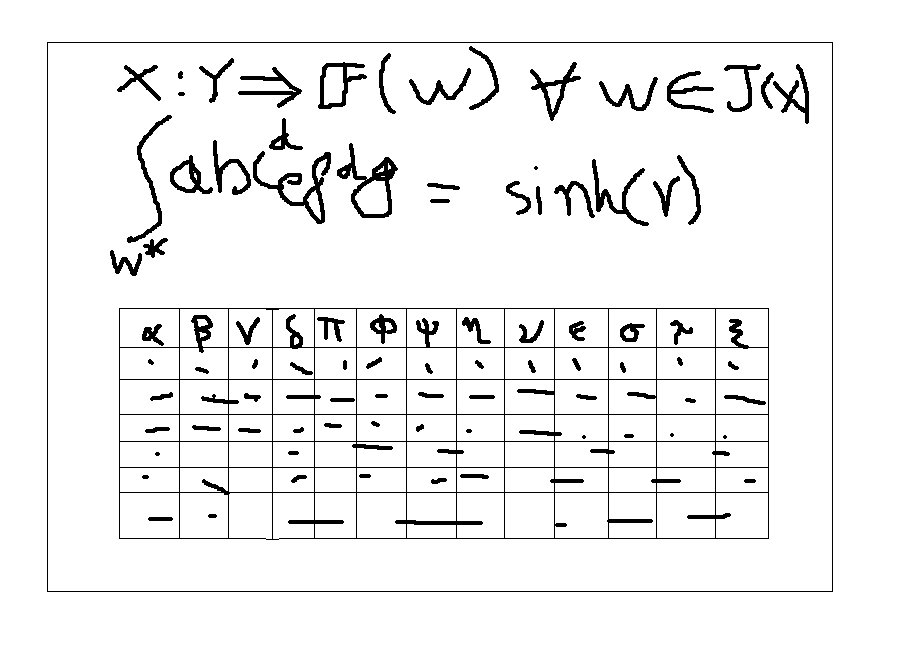
I prepared two distinct documents for the meetings. The first one, done as all respectable blah documents are done, was prepared using LaTex. It looked something like the schematic to the left. All the intricacies of both the formulation and the analysis laid bare open for the sake of blah peer review!

I spent a few hours and Latexed like i had never Latexed before, discovering new .sty files and packages and writing new \define statements with impunity, all the while boldly going where few blahs had gone before. I was happy with myself at the end of it.

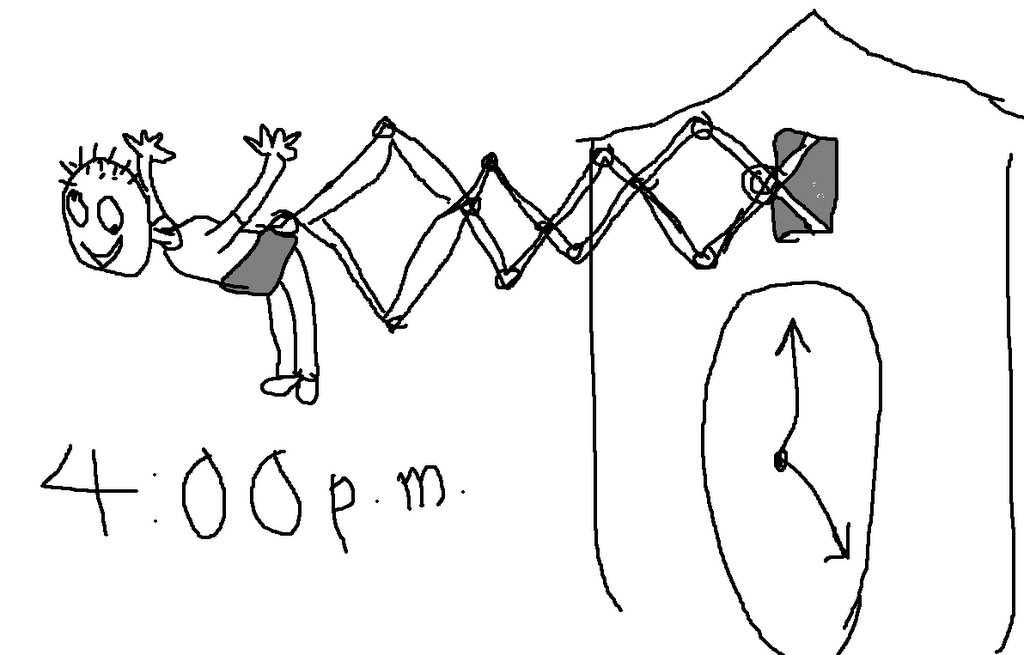
The other document was meant for the duhs. It looked something like this image here to the right, and i need say nothing more than that a picture is worth a thousand words (and that phrase applies here twice, if you get my drift.)

Needless to say, there was a mixup, and it was copies of this document that were sent across to the blahs. On the day of the presentation, I arrived, armed with the original document, and started the talk, when I noticed disappointed looks from the audience.

"Your handouts don't match your slides", a senior blah in the audience complained.

Realizing the error, I started apologizing furiously, when I was interrupted with a, "Don't apologize, we'd rather have the handouts than what you are presenting", from another senior blah.

"How exactly *did* you do this?"

"Er... Powerpoint", I said meekly.

"You can *do* all these things in Powerpoint? I didnt know it was so powerful. It looks very impressive. What do all of you think?"-he looked around quizzically.

I looked around and realized that all the blahs in the room was nodding their heads. I could barely suppress a groan.

Thursday, March 23, 2006

A Room with a View

Those of you who know what we do for a living (and are in similar situations in life) will be pleased to note that we recently moved offices to a room with a window. For the moment let us abuse our notation a little bit and loosely use that term for a smallish hole in the wall that lets you see outside. Gone are the days when we had to look at a clock to figure out if it was day or night. Yes sirree, we know by the light that streams in through our window.

My window (said in the same tone as 'My precious') is triangular - a right angled triangle with a convex hypoteneuse. Convex - oh, how i love that word. It brings to mind convex graphs and convex sets and other such words. I occasionally use them to show how real-analytically-proficient i am.

It opens onto a view of another building - a building with red walls that happens to be a library. There isnt too much of a view of anything else - if you really strain, you can make out what appears to be the sky. And you can catch glimpses of a path between our two buildings. Not that open skies and such things have any use for us. Countless nights spent in the cell-like environments of the big room aka the bat-cave aka the fountain of scholarship have made us allergic to open skies and sunny days. Sunny days, especially, for they make others happy, and, by the law of conservation of happiness, contribute to our misery.

The view is nice. Libraries can be interesting places. I get to see other people because my window opens on to a library. I used to know people once. There was something exciting about that, but I cannot put my finger on what it was.

Most of the time, the people in the library have their noses buried in their books. But occasionally something really interesting happens. Like the other day, I saw a girl talking into her cellphone. And the most exciting thing that has happened in my life in a long long time - I saw someone smoking through an open window in the library. That does not happen too often.

My window makes me happy. And no, you may not have it.

Thursday, March 16, 2006

Tuesday, March 07, 2006

Communication

I am talking to you about poetry
and you say
when do we eat.
The worst of it is
I’m hungry too.

~ AliciaPartnoy

This poem is part of the poetry in motion series on the New York subway. You will see it rather frequently, and having had the opportunity to ask people what they felt about this poem, I have realised that it is like a Rorschach test of sensibilities. Different people react differently to this.

Friend J hates the concept of being in a relationship. He has spent the last few years moving in and out of short-term flings that never last more than a month. He thought that the poem showed how domestication kills romance, "the sort of smugness that causes people to become fundamentally disinteresting after they spend too much time with each other"

Another friend, who belongs to that annoying club of people who are madly in love and gush and coo about it thinks of it as an incredibly romantic poem.
"It describes a situation where two people become so much a part of each other that one person's desires induce similar desires in the other person, the kind of relationship that all of us secretly aspire to", were her exact words.

I, on the other hand, think that this poem is about the power of the culinary over the poetic. Self-deprecatory because it places food before poetry, it is about the triumph of food over other forms of human expressions. But then I am obsessed with food to the point that I have almost gone to jail for stalking it.

There are, of course, other possible points of view. More general ones, in a manner of speaking. I asked friend W, a beer drinking,'gidday-mate' wishing buddy from Oz about it while travelling on the subway, the other day.

"That's gay stuff mate, pomes and what not", was the only thing he said.

Update: This is what Falstaff has to say:

"Personally, I think it's about the poem as hunger, the poem as need. Marianne Moore famously said 'these things are important not because some high-flown interpretation can be put upon them, but because they are useful'. That, I think is the point of the poem - that true poetry isn't about intellectual discussion, it's about the immediacy of wanting something, about a need inside us crying out be fulfilled. Denise Levertov describes it well: "living in the garden and being hungry and eating the fruit"."

Tuesday, February 28, 2006

Nihilistic demonstrations

I live in an incredibly messy room. I always have. Back in the days when i was getting a real education, as opposed to a pretend one, i was renowned for having the messiest room at WIMWI (Well known institute of management in western India). This probably reflects the fact that I am a Nihilist at heart, as opposed to those pseudo-intellectuals who live well organized lives in spick and span apartments, but claim that life has no meaning.

Many people are confused about what messy means. The other day, I was having a conversation with this girl - the proverbial "Your place or my place" conversation, and I was somewhat insistent that I would go over to her place. She found this a bit odd, so I had to express my apprehensions about her coming to my rather unkempt dwelling, and subsequently fleeing in digust.

"Oh, Big Deal. I have books lying around on the floor too and I haven't done my laundry for a couple of weeks. And I haven't cleaned my room in a couple of months", she said.

Her statement only made me think of her as a cleanliness freak. For when I say messy, this is what I mean.

1. You keep your valuables under a pile of dirty laundry in a corner of the room.

2. You don't quite remember how that pile got there. The details are lost in antiquity.

3. The Rooh-Afza that a friend spills on your floor (an entire half-bottle of it) is never cleaned. (don't ask me what the Rooh-Afza was doing there - it was an alcohol related incident. We were trying to make interesting cocktails). Eventually it dries, and gathers a coating of dust and body hair, becoming positively plush in the process. You end up with a homemade rug.

4. The occasional dead mouse or dead cockroach turns up in your room, having ingested food that has been lying around and gone toxic by virtue of having been there.

5. There is a bowl of yogurt by your bedside. There is a garden of fungus in it. You watch it with fascination everyday, waiting for the day it will evolve a pair of legs and scamper away.

6. You accidentally brush the layer of dust on your desk and find keys that you have been looking for a long time.

7. You have never cleaned your sheets. Rogue regimes get in touch with you because of your expertise in developing biological weapons. (I was, of course, humbled in this endeavor by the great LM, who did the same thing with underwear.)

8. A pigeon builds a nest on top of your shelf.

9. The pigeon lays eggs, but leaves, disgusted with your room.

10. The nest and the eggs are still there, a year after the event.

Needless to say, I'm going to have a HazMat team over. Just in case she insists it be my place.

Monday, February 20, 2006

"the spirit of freedom"?

I am on a flight from Delhi to Mumbai, having attended a rather dear friend's wedding - tired, bored, depressed and somewhat lonely. Two successive weddings, two more friends who will never hang out with me without making statements like, "I'm sorry I have to go. My wife is having a bad day." Or, for that matter, without talking about the chest of drawers they plan to buy. I feel strangely empty - a feeling that something has been missing from my life.

A girl walks into the plane, and in what could be a sequence from that late eighties 'lakme moisturizer ad', she looks around. the seat next to me is vacant, and it turns out that it is her's. what is notable about the girl is the big guitar she's lugged into the plane. (the jury may note that a guitar is kind of hard to miss). since there is no space in the overhead bin right above, it takes a considerable amount of time and effort on the part of the cabin crew to find a suitable abode for the damned instrument. after making small talk about guitar intricacies (since one of us seventeen plays the instrument somewhat), it turns out that we have mutual acquaintances.

"I just saw rang de basanti", she suddenly declares. "You should watch it"
"I will. I have been hearing lots about it too. So tell me, what do you think of the movie?"
the plane taxies to the end of the runway and accelerates.
"It's about the spirit of freedom."
"Muh?"
"Hard to explain it. Look outside. Look at how everything blends together when you travel at high speed. And then you flyyyyyyyyyy! That's what it's like."

Epiphany. A moment when everything falls in place. I am rather moved by her observation. This girl clearly has hit on something that has been missing from my life for a long time. Turning around, I look deep into her eyes and catch a glimpse of her soul - that's how dilated her pupils are. Yes, ladies and gentlemen, she's as high as a cloud. She's hit on the blessed weed.